Should the agent even look that up?
We listed memory as a use case when we launched strands-decider. I went and built it: a decision model gating long term memory retrieval in a Strands agent. Eight memory calls became three and 147 injected records became 25, with the answers unchanged. The wording of the question mattered more than anything else.
All the code, both tuning harnesses and the script that builds and seeds the memory store are on GitHub: github.com/mikegc-aws/decider-gated-agentcore-memory. This post is the writeup. The repo lets you re-run any number in it.
A caveat up front. What follows is one afternoon’s worth of measurement on a synthetic memory store, with labels I wrote myself. I have tried to be quantitative where I can, but the sets are small enough that you should read direction and not magnitude. I should also say plainly that I am not a neutral party here, so discount accordingly.
I am one of the authors on the strands-decider launch post, along with Marc Brooker and Fabio Nonato de Paula. In that post we list the places a decision model earns its keep, and memory is one of the words in that list.
Lists are cheap. What a list does not tell you is whether the idea survives contact with a real retrieval path, what the question has to look like before it works, or how much of the win is still there once you measure it rather than assert it. Writing “memory” in a use case list took me about four seconds. So I went and built the memory one properly, to find out whether we had earned the word.
A quick description for anyone who has not met it. strands-decider is a 2B open source decision model, and it does not generate text. You hand it some state and one or more typed questions, and it returns probabilities with a calibrated confidence, and extra questions about the same state cost almost nothing. Under the hood it is a Qwen3.5-2B torso with the language model head replaced by a small pointer head and tuned with a LoRA, which Marc wrote up in detail here. It runs locally. pip install strands-decider, median latency around 115ms on an RTX 3090 and about 153ms on an M3 MacBook, weights and training data on HuggingFace, code at strands-labs/strands-decider.
Here is the question I started with. When an agent has long term memory, something has to decide what to recall on each turn. Does that decision deserve a model?
What Strands does today
AgentCoreMemorySessionManager, in the bedrock-agentcore SDK, wires Strands up to Amazon Bedrock AgentCore Memory. It writes each message to the memory service as an event, and it registers a MessageAddedEvent hook, retrieve_customer_context, for the way back in.
That hook is all of the retrieval logic. On a user text message it fans out over the configured namespaces, runs a semantic search with a topK, drops anything under a fixed relevance_score, and splices what is left into the user’s message inside a <user_context> block.
It is about seventy lines, and to be fair to it, it is doing a sensible default thing. But it makes two decisions implicitly, and I think both are more interesting than they first look.
Decision one: should we retrieve at all? The hook’s only condition is “is this user text”. So a greeting runs a semantic search over the user’s stored history before the agent says hi.
Decision two: which of the returned records belong in the prompt? The answer today is “the ones above a fixed score”. Whether that works depends entirely on how the scores are distributed, which is worth actually looking at.
The score distribution does not cooperate
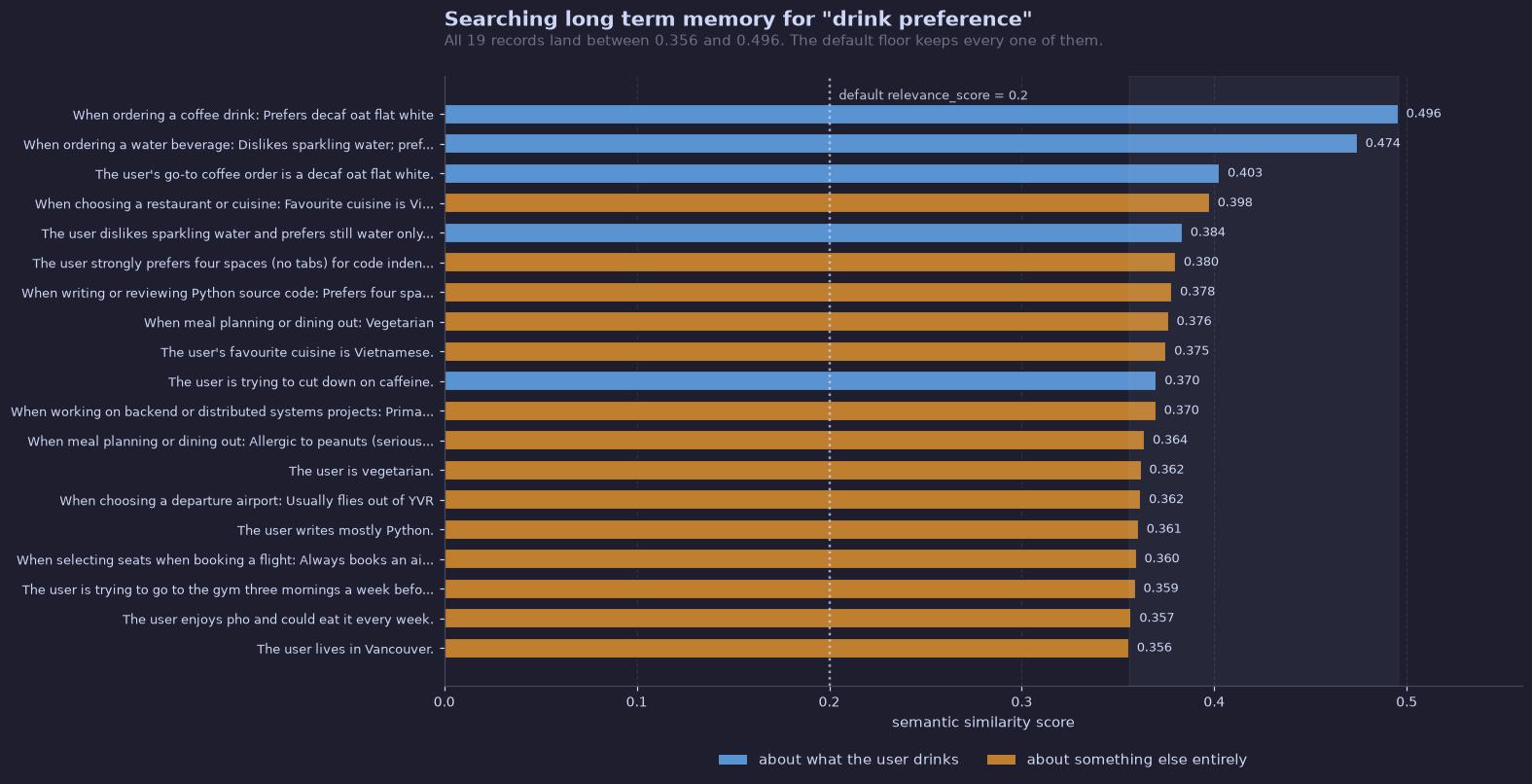
I seeded a store with five short conversations about an invented person, covering drinks, food, travel, work and a dog. AgentCore’s extraction produced 19 long term records. Here is what a search for “drink preference” returns, best first:
1
2
3
4
5
6
7
0.403  The user's go-to coffee order is a decaf oat flat white.
0.384  The user dislikes sparkling water and prefers still water only.
0.380  The user strongly prefers four spaces (no tabs) for code indentation.
0.375  The user's favourite cuisine is Vietnamese.
0.370  The user is trying to cut down on caffeine.
...
0.356  The user lives in Vancouver.
Here is the whole result, coloured by whether the record is actually about what the user drinks.
The indentation preference scores above the note about cutting down on caffeine, for a question about drinks. I do not think that is a defect in the embedding. It is being asked “what here is about this subject”, and it answers that; “which of these should the agent say right now” is a different question that nobody asked.
The part that matters for the fixed threshold is the spread. All 19 records land between 0.356 and 0.496, and the relevant and irrelevant ones are interleaved through that band. There is no value of relevance_score that keeps the top record and drops the bottom one. The default is 0.2, so in practice everything gets through. Over an eight turn conversation the stock manager put 147 records, roughly 2,500 tokens, into the prompt, including on the turns “Hello!”, “What is 17 times 23?” and “ok cool”.
So, two candidate questions for a classifier. Let’s take them in order.
I ran everything twice, against strands-decider and against TypeSafe’s Jev through OpenRouter. Both take the same state plus typed questions shape, so the integration has one interface and two clients behind it. Partly that is because I wanted a second opinion from a model I had no hand in, given I am hardly impartial about the first one, and partly because if the gating idea only worked on our model it would be a much less interesting idea.
One structural note before the questions. This is the first of these integrations where I could not use a clean extension point. Writing about Jev in Strands last time, six of my seven experiments needed no wrapper, no fork and no patch. This one needed a subclass of the session manager, overriding retrieve_customer_context and nothing else. Seventy lines of policy replaced, about 1,300 lines of plumbing inherited untouched, because the write path is not the part I am questioning.
Question one: is a lookup worth making?
This one is cheap to ask, because it runs before any network call and needs one noul question. Here is the wording I reached for first:
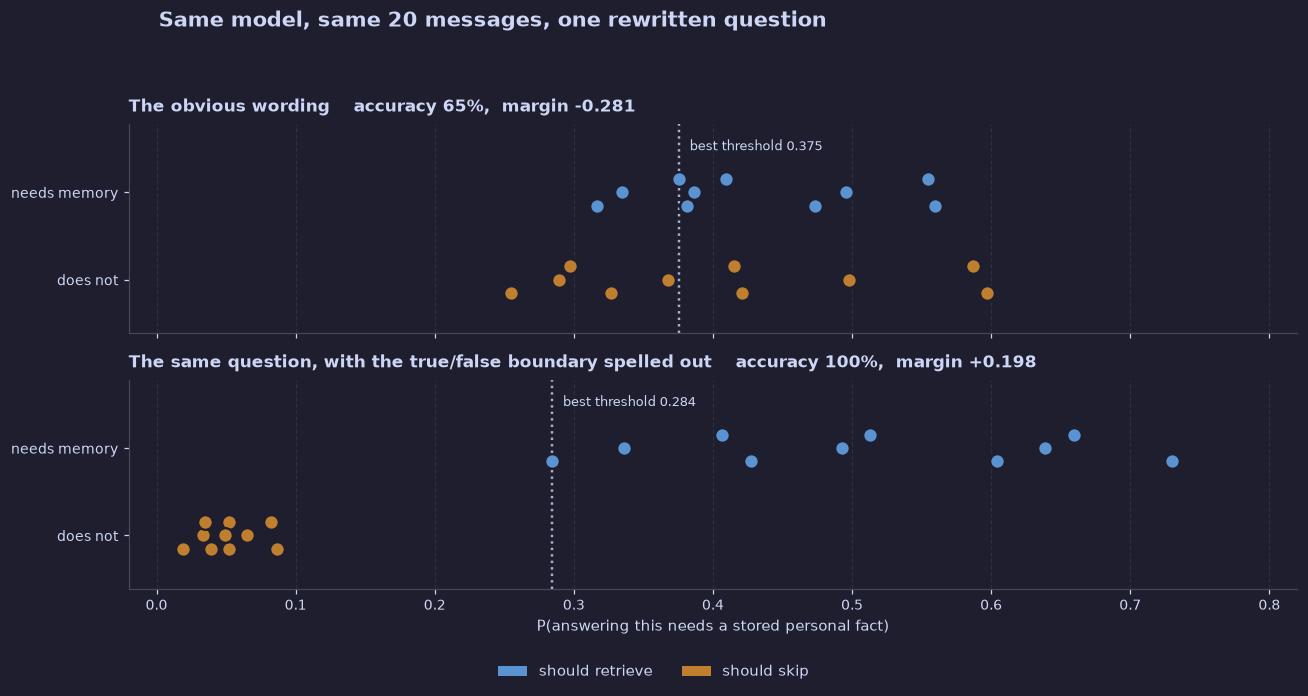
Answering this message well depends on recalling a stored personal fact or preference about this specific user.
That scores 65% on 20 labelled utterances, which is close to worthless when the baseline I am trying to beat is “always retrieve”. The errors are not even politely distributed. “What’s the capital of France?” came back at 0.597 and “review this function and match my usual style” at 0.316, which is the wrong way round.
The same proposition, with the boundary written into criteria, scores 100% on the same set in the same minute, lowest positive 0.284 against highest negative 0.086.
| gate wording | best accuracy | margin |
|---|---|---|
| the plain version above | 65% | -0.281 |
the same question, with criteria | 100% | +0.198 |
| “would a profile lookup change the answer” | 90% | -0.025 |
| inverted, “answerable without knowing the user” | 95% | -0.118 |
a four level score version | 95% | -0.049 |
I am slightly embarrassed to report this, because the last time I wrote about one of these models I concluded that question design was most of the work, and then I went and wrote a lazy question. The criteria field is where nearly all of the quality lives. If you take one thing from this post, take that, and take that it costs 20 requests to find out, since all five candidate wordings go in a single call per utterance.
Question two: does this record belong in the prompt?
Harder, and this is where I got it wrong in a way that is worth describing.
My first attempt used the obvious wording with an absolute cut at 0.5. It dropped “the user’s go-to drink is a decaf oat flat white”, at 0.484, in reply to “I’d like a drink, what should I get?”. It also dropped “vegetarian diet” at 0.499 for “what should I have for dinner?”. The single most useful record, binned, with the gate working perfectly upstream of it.
What I had done was measure one thing when there were two. So I started scoring both, across four queries with about nine records each:
- Separation. Pool every judgement. Is there one absolute threshold that splits relevant from irrelevant?
- Ranking. Within a single query, do the relevant records outrank the irrelevant ones? Per query AUC, and precision at k where k is the number of truly relevant records.
| validator wording | pooled margin | best acc | mean AUC | mean P@k |
|---|---|---|---|---|
| plain | -0.022 | 80% | 0.835 | 69% |
with criteria | +0.038 | 100% | 1.000 | 100% |
| topical overlap | -0.401 | 77% | 1.000 | 100% |
| counterfactual, “would omitting it hurt” | -0.137 | 74% | 0.490 | 29% |
graded score | -0.105 | 91% | 0.935 | 85% |
Look at the topical overlap row. Perfect ranking, AUC 1.000 and precision at k of 100%, and useless at any absolute threshold, margin -0.401. Had I measured only separation I would have discarded a wording that ranks flawlessly. Had I measured only ranking I would have shipped it behind a fixed threshold and watched it drop everything. One number hides whichever of the two you did not think to look at, and I only found this because the first version failed loudly enough to make me look.
The counterfactual row is the one I keep thinking about. AUC 0.490 and precision at k of 29% put it slightly below chance, so it is not merely weak, it is pointed the wrong way. “An assistant that did not know this would give a noticeably worse answer” reads to me like a sharper question than “is this useful”. My guess, and it is only a guess, is that it asks for a counterfactual judgement of value rather than a property you can check against the text in front of you. I would not want to defend that explanation without more cases.
The winning wording puts relevant records at 0.379 and up, irrelevant at 0.341 and down, so I set the threshold at 0.36. That is a gap of 0.038, which is narrow, and I would retune before trusting it anywhere else.
One confound I nearly shipped
AgentCore’s strategies do not return the same shape as each other. SEMANTIC gives prose. USER_PREFERENCE gives JSON:
1
2
3
{"context": "Ordering a drink or beverage",
 "preference": "Dislikes sparkling water; prefers still water only",
 "categories": ["beverages", "water"]}
The stock manager passes that through as-is, and a frontier model copes. The classifier copes less evenly, and the bias was systematic rather than noisy. JSON records scored above prose records more or less regardless of relevance. A threshold tuned on prose therefore let JSON through, which is how “always books an aisle seat” survived a question about what to drink.
Rendering both strategies into one prose style first (“When ordering a drink or beverage: Dislikes sparkling water; prefers still water only”) sorted it out. On the drink query the kept set went from 10 records to 7, and the three that flipped were the indentation preference, the favourite cuisine and the aisle seat.
I apply that rendering on both sides of the comparison below. Otherwise I would be measuring my own tidying up.
What it bought
Eight turns, same store, Claude Sonnet 4.5 answering. The baseline arm is the stock behaviour, which I get by passing decider=None so every gate branch is bypassed rather than by running different code.
| stock | gated, 2b | gated, Jev | |
|---|---|---|---|
| memory retrievals | 8 | 3 | 3 |
| records injected | 147 | 25 | 16 |
| context injected | ~2,471 tokens | ~369 tokens | ~253 tokens |
| memory service time | 4,230 ms | 1,900 ms | 1,745 ms |
| decider calls | 0 | 14 (4,867 ms) | 14 (7,210 ms) |
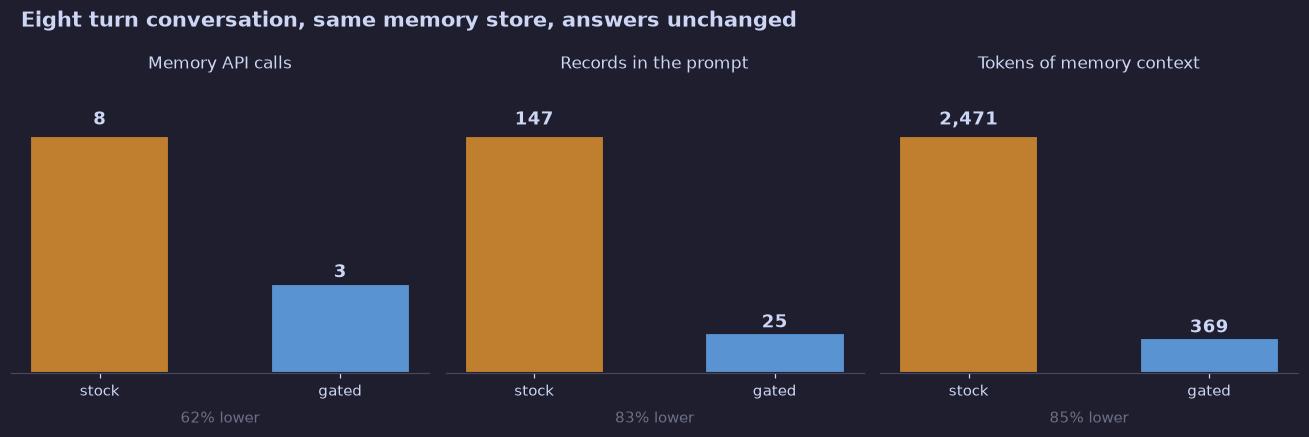
The gate closed on the five turns you would hope for, “Hello!”, “What is 17 times 23?”, “Thanks!”, “Can you explain what a bloom filter is?” and “ok cool”, and opened on the three that needed memory. Answers held up. Both arms recommend the decaf oat flat white, both remember the aisle seat and the home airport when a flight comes up, both suggest vegetarian pho with a peanut warning. The gated arm does it on about 15% of the context.
What this does not show
Wall clock was 29.9 seconds gated against 29.3 stock. That is a wash, and the honest reading is that I have not demonstrated a latency win.
The reason is mundane, and it is my own fault rather than the model’s. For this experiment I was calling a copy of the model on a remote SageMaker endpoint, from a laptop in a different region, so each call cost roughly 350ms of round trip against 50 to 70ms of actual work at the far end. Fourteen calls of avoidable network is about the 2.3 seconds saved on the memory service, which is why the two arms finish together.
That is a deployment choice I made early and should have revisited, because the released model does not work that way. It is a pip install that runs on the machine you are already on, at around 153ms on an M3 MacBook. A local call has no round trip to pay for, so I would expect the latency column to go positive. I have not run that configuration, so treat it as the obvious next measurement rather than a result.
The comparison is also unfair to the stock manager in one direction that I should name. It is tuned for a general case and I tuned my thresholds on this store, with these 19 records, using labels I wrote. A fixed relevance_score would also look much better on a store whose scores were well separated. I have shown that this store defeats a fixed threshold, not that fixed thresholds are a bad idea in general.
So the two claims I will stand behind are the 85% reduction in injected context and five of eight memory calls avoided. Everything else here is direction.
Failing open hides outages
Both gates fail open. If the classifier errors, the gate retrieves and the validator keeps the batch, so a dead dependency costs you the optimisation rather than the agent’s memory. I am fairly confident that is the right default.
It also bit me immediately. Making the endpoint name configurable, I set the default to a name that does not exist. Every decision errored, every one failed open, and the demo produced entirely correct answers. The only evidence was the stats block reading oddly:
1
2
gate decisions             8  (open 0, closed 0)
memory retrievals made     8  (baseline would be 8, saved 0)
Eight decisions, none of which opened or closed anything. I had to read my own code to work out why, which is not a great sign. There is now a counter that says so loudly:
1
!! decider errors          16  (failed open -- results below reflect UNGATED behaviour)
The general lesson, which I suspect generalises past this project, is that fail-open and observable are not the same property, and a system that degrades silently to “the old behaviour” is indistinguishable from a system that is working. Count the failures.
Where that leaves me
The division of labour I end up with is roughly this. The embedding is good at “what in this store is about this subject”, and that is not the question the agent needs answered on a given turn. “Is this worth saying right now” is a judgement against evidence already in hand, which seems to be the shape these small classifiers are reliably decent at.
The thing I did not expect going in is that the gate is both the cheaper half and the easier half. Deciding whether to search at all is a judgement about one short message, and one carefully worded question got it to 100% on my set. Deciding whether each record belongs took four wordings and is where all the threshold fragility sits. If you only build one of the two, build the gate.
Three things I have not built and would try next. Run the classifier locally, the way it is actually shipped, and settle the latency column properly. Route rather than only gate, since the gate is a single noul and a choice in the same request could pick which namespace is worth searching, so a question about drinks never searches travel memories. And see whether the ranking signal can replace the absolute threshold, because ranking was stable for both models at AUC 1.000 across every run while the thresholds were not. Jev’s absolute values drifted enough between runs to move its best threshold, though the 2b model’s stayed put.
So, did we earn the word in the use case list? I think so, with a caveat I would not have thought to write before doing this. The mechanism works, and on this store it removed five of eight memory calls and 85% of the injected context without costing the agent anything it needed. But “use a decision model for memory” is not the useful instruction. The useful instruction is “write the question twice, measure both, and measure ranking separately from separation”, because the first wording I tried was worth 65% and would have made the whole thing look like a dead end. The mechanism was never the hard part.
A closing warning on the code. It is a subclass reaching into a part of the bedrock-agentcore SDK that was refactored once while I was working on it. Treat it as a spike rather than a library. It will break.