Will AI Ever Have Original Thought?
The question I was asked, taken seriously. Four experiments later: under the only definition we can test, machine originality is already real, provable in a 111k-parameter model. What's missing is expression, not ability. Here's why.
All code, data-generation scripts, and result tables for this project are on GitHub: github.com/mikegc-aws/original-thought. This post is the self-contained writeup; the repo lets you replicate any of it.
I get asked plenty of questions about AI, and most of the time I’m pretty comfortable answering. But when Darko Mesaroš asked me will AI ever have original thought? I wasn’t happy with my intuition alone, so I said I would get back to him. Darko: in this post, I am reporting back on what I found.
Let’s start off by doing what most folks would do, and ask/test a frontier LLM. So I asked ChatGPT (with memory disabled): “Write an original and novel idea that has not been done before.” It gave me a decent-sounding idea. Then I asked again, in a fresh session. Same idea. Again, same idea, worded slightly differently. Whatever I did, the model had exactly one “original idea,” and it was always that one.
That felt like it should settle the question, but which way? Does a model that returns one idea have one idea? Or was I measuring something else entirely? Let’s stop speculating and build a research project around it. This post is the full writeup: four experiments and a reasoned conclusion.
TL;DR: yes (qualified)
Here’s where it lands, up front, because the rest of the post is the “why”: ever is the wrong word. Under the only version of the question anyone can actually test, AI can already produce original thought, I’ll show a 111,000-parameter model doing it, provably, hundreds of times. What’s missing from the models you use every day isn’t the capability; it’s the expression of it. The rest of this post reframes the question into something answerable, then explains why the answer is already yes and why we so rarely see it. I’ve tried to include enough detail that you could replicate any of it.
First, the question had to be made testable
“Original idea” is doing a lot of unexamined work in that question, so before running anything I pinned down definitions I could measure against.
Creativity research has a useful distinction from Margaret Boden (1998): P-creative means new to the creator; H-creative means new to all of history. H-creativity turns out to be untestable in principle, for humans too, since nobody can enumerate every idea ever had. Any measurable claim about novelty is really P-creativity against some body of experience. For an LLM, “new to the creator” can be pinned down to: new relative to the training data. That’s the version we can test.
Second definition: originality is not novelty alone. Random word salad is maximally novel and worthless. An original idea has to be both novel and coherent/valid.
Third, a word that was bound to come up: emergent. People love saying abilities like this “emerge” once a model gets big enough, and my take has always been that “emergent” is often just a fancy way of saying we don’t know why this happened. So I decided the word would have to earn its place. Before running anything, I fixed a strict test for it: an ability only counts as emergent if a yardstick I pick in advance stays flat near zero for small models, then shoots up once the model passes some size.
And I’d measure it two ways at once. One is pass/fail, did the model clear the bar or not? The other is a smooth score that can register partial progress. Both, because of a well-known result (Schaeffer et al., 2023): many of the famous “emergent” jumps in AI turn out to be an illusion created by pass/fail scoring. Picture a student who gets a little better at algebra every month but scores 0% on the exam until the day they can finally solve a whole problem, then suddenly 60%. The skill grew gradually; the yes/no test just couldn’t see it until it crossed the line, making steady progress look like a sudden leap. Measuring the smooth version alongside the pass/fail one is how you catch that.
Experiment 1: measuring the thing I saw
The first experiment reproduced my original one, at scale: 4 models on Amazon Bedrock (Claude Sonnet 4.6, Claude Haiku 4.5, Nova Pro, Llama 3.3 70B) × 5 sampling configurations × 50 samples each, 1,000 generations of “an original and novel idea.” I embedded every response (Titan v2, 512 dimensions), clustered them (agglomerative, average linkage, cosine distance threshold 0.45), and measured what fraction of each model’s 50 answers fell into the single largest cluster, i.e., were the same idea.
At default-ish settings (temperature 0.7, the bare prompt):
| model | share of 50 samples that are one idea |
|---|---|
| Llama 3.3 70B | 92% |
| Claude Sonnet 4.6 | 70% |
| Claude Haiku 4.5 | 52% |
| Nova Pro | 18% |
At temperature 0, three of the four models produced the identical idea all 50 times.
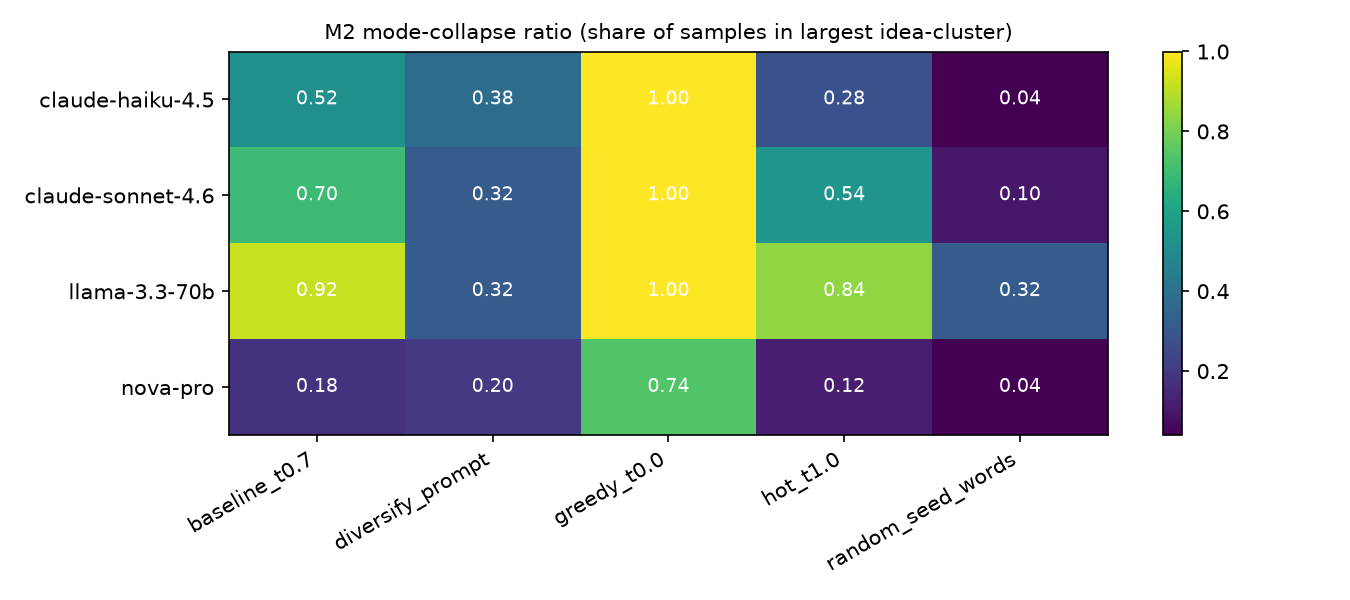 Mode-collapse ratio (share of the 50 samples falling in the single largest idea-cluster) for every model × config. Greedy decoding collapses almost everything; two random seed words in the prompt (right column) breaks it at the same temperature.
Two details changed how I read my original experiment. First, each model has a different pet idea. Claude Sonnet always pitched a “Grief Cartographer” (an app that maps grief as an evolving landscape). Haiku pitched “Temporal Debt” (an economy where time is the borrowed currency). Llama pitched a biometric art installation; Nova an emotion-sensing haptic garment. So there is no single answer LLMs converge on, the repetition is a property of each model, not of the question. Though notice the four pet ideas are all the same kind of thing: emotion-made-tangible-through-technology. The genre itself is collapsed.
Second, and this reframed everything, the repetition is trivially breakable. I added two random words to the prompt (“Here are two random words: ‘lantern’ and ‘kelp’. Using them only as loose inspiration, write an original and novel idea…”) and re-ran everything at the same temperature. The one-idea share fell to 4–10% for three of the four models, and from 92% to 32% for Llama, the worst offender; effective idea counts (the Vendi score of Friedman & Dieng, 2023, roughly the number of genuinely distinct ideas in the sample) rose for every model, with the three most collapsed going from 2–7 to 17–30 out of 50. I also had a judge model not in the test pool (Claude Opus 4.5) blind-score ~15 outputs per condition for coherence and value on a 1–10 rubric: coherence stayed between 8.4 and 9.7 across every condition. The diverse ideas were exactly as well-formed as the collapsed one.
So my original experiment hadn’t measured what the model can produce. It measured where the probability mass sits. The model contains a landscape of ideas; training has worn one valley very deep; the unmodified prompt rolls into it every time. Cranking temperature shakes the ball a little. Changing where the ball starts, two random words, matters far more.
Experiment 2: but is any of it actually new?
Diversity isn’t originality. Fifty different ideas could be fifty paraphrases of things people have already done. So the second experiment built a reference corpus of 9,445 real existing ideas, 5,771 Y Combinator company descriptions plus 3,674 recent arXiv abstracts from cs.HC (human-computer interaction) and cs.CY (computers and society), embedded in the same space, and measured how far each generated idea sits from its nearest real neighbor.
Raw distances mean nothing alone, so I calibrated: hold out 500 real ideas, measure how far each sits from the nearest other real idea. Median distance: 0.548. That’s the yardstick for “as novel as ideas normally are.”
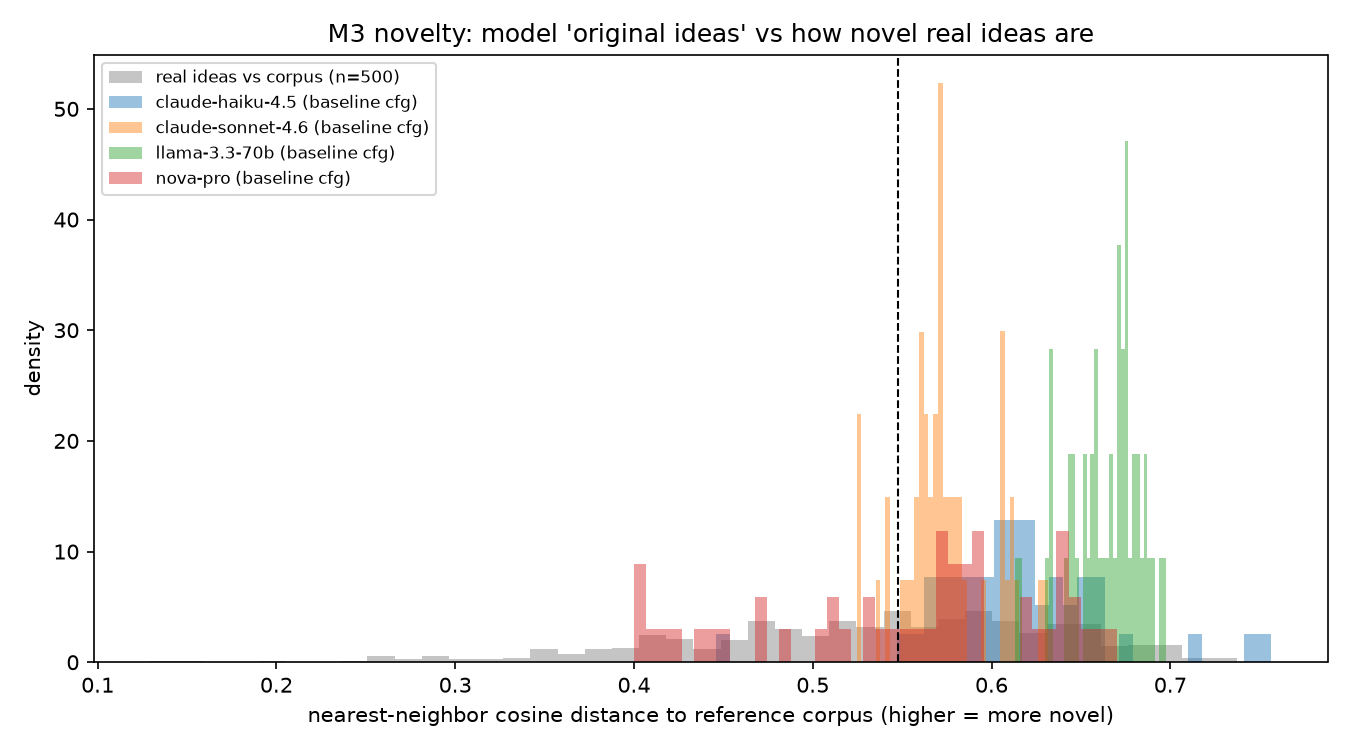 Nearest-neighbor cosine distance to the corpus of 9,445 real ideas. Higher = more novel. The dashed line at 0.548 is the real-vs-real human baseline. Model medians land at or beyond it, but note the left tail poking under the baseline.
The results cut both ways. The median generation from Claude and Llama sits at 0.56–0.67, at or slightly beyond the human baseline. Typical LLM “ideas” are about as far from existing ideas as existing ideas are from each other. Ordinary recombination: not plagiarism, not breakthrough.
The bad tail is worth seeing, though. Nova Pro’s pet idea, the emotion-reading wearable, sits at distance 0.40 from an actual YC company called Anoria, whose pitch is “the first wearable that reads your emotions to enhance your EQ.” Nearly point for point the same product. 74% of Nova’s greedy-mode generations sat closer to an existing real idea than real ideas sit to each other, every one asserting “this has not been done before.” The model has no mechanism for checking that claim. “Original” in a prompt is a style instruction, not a verified property.
This experiment has an honest ceiling, and it’s what drove the next one: my 9,445-idea corpus is a rounding error against trillions of training tokens. An idea far from my corpus may still be near something the model read. With frontier models you can never close that gap, because you can never enumerate their experience. So I stopped using frontier models.
Experiment 3: making novelty provable
This is the experiment the whole project rests on, so here is all of it.
The world
To prove an output is outside a model’s experience, you must own the model’s entire experience. So I built a closed world: a language of inventions. Every sentence describes a triple, a device, a mechanism, a purpose, drawn from 50 invented pseudo-words of each type (150 total, generated as pronounceable syllable combinations: “flotror”, “dorfi”, “parsor”). A triple renders as a sentence through one of three templates:
1
2
3
the {device} uses {mechanism} to {purpose} .
with {mechanism} the {device} can {purpose} .
a {device} is able to {purpose} using {mechanism} .
That gives 50³ = 125,000 possible inventions. Hidden underneath: every word secretly belongs to one of 5 latent classes (word #1 → class 1, #2 → class 2, … assigned round-robin, so classes are balanced). A triple is valid only if the device’s class is compatible with the mechanism’s class, and the mechanism’s class is compatible with the purpose’s class, where each class is compatible with exactly 2 of the 5 classes on the other side, chosen at random and fixed. Result: exactly 20,000 of the 125,000 triples (16%) are valid. The classes and compatibility rules appear nowhere in any training sentence. If a model is to respect them, it must infer them from co-occurrence statistics alone.
Then I locked combinations away, at two depths:
- L1 holdout, 1,840 valid triples removed from training. The individual words and even the device–mechanism pairs still occur in other training sentences; the specific three-way combination never does. Producing one is novelty at the level of “this exact idea was never seen.”
- L2 holdout, 1,600 valid triples, built by picking 80 valid device–mechanism pairs and scrubbing every sentence containing those pairs from training. The model never sees those two words together in any context. Producing a valid L2 triple can’t be done from pair memory, it requires the latent class rule.
The remaining 16,560 valid triples became the training set, each rendered in all 3 templates: 49,680 sentences. A sanity check confirms every one of the 150 words still appears in training, so no output can be dismissed as involving unseen vocabulary.
The payoff of this construction: an exact, instant classifier for every generation. Memorized, provably-novel-valid (L1 or L2), rule-breaking, or ungrammatical, no embeddings, no similarity thresholds, no judgment calls.
The model and how it was trained
I trained GPTs from scratch, every weight from random initialization. This is non-negotiable for the logic of the experiment: fine-tune any existing model and it arrives with trillions of tokens of unknown experience, and the skeptic’s “it saw something like that somewhere” objection comes straight back. From-scratch training on an enumerated corpus is what makes “outside its entire experience” a checkable statement rather than a vibe.
The architecture is a standard decoder-only transformer, the same family as frontier models, at dollhouse scale:
- Token embeddings + learned positional embeddings; vocabulary of 163 tokens (the 150 pseudo-words, 10 template words, punctuation, and BOS/EOS/PAD markers, one token per word, no subword tokenizer needed in a closed world)
- N identical pre-norm blocks: LayerNorm → causal multi-head self-attention, then LayerNorm → 4× MLP with GELU, residual connections around both, dropout 0.1
- Output head weight-tied to the input embeddings
- Context window: 12 tokens, one full invention sentence
Seven sizes, spanning ~6,000× in scale, three random seeds each (21 runs total):
| name | layers | heads | width | parameters |
|---|---|---|---|---|
| s0 | 1 | 1 | 8 | 2,288 |
| s1 | 1 | 2 | 16 | 6,112 |
| s2 | 2 | 2 | 32 | 31,072 |
| s3 | 2 | 4 | 64 | 111,296 |
| s4 | 4 | 4 | 128 | 815,744 |
| s5 | 6 | 8 | 256 | 4,783,872 |
| s6 | 8 | 8 | 384 | 14,263,680 |
Training: next-token prediction (cross-entropy, padding masked), the same objective frontier models use, which is the point: whatever behavior appears is attributable to the objective, not to any creativity-specific trick. 6,000 steps at batch size 256, AdamW (lr 3e-4, weight decay 0.01, cosine decay), identical recipe at every size. All 21 runs, training and evaluation, took under half an hour in total on one AWS g6.xlarge (a single NVIDIA L4). For calibration, the largest model here is ~100,000× smaller than a trillion-parameter frontier LLM.
Evaluation, identical for every run: sample 4,000 sentences unconditionally at temperature 1.0, classify each one exactly, and separately compute a continuous metric, the mean per-token log-probability the model assigns to 500 held-out valid triples versus 500 invalid ones. That log-prob gap is the smooth companion to the pass/fail novelty metric, included specifically for the emergence question.
Sample results, what the generations look like
Real output from the trained models, with the classifier’s verdicts:
1
2
3
4
5
6
7
8
[memorized]  the flotror uses dorfi to parsor .
[memorized]  with kresko the nirgrubi can felkir .
[L1-novel]   with skopitre the nirgrubi can belselvli .
[L1-novel]   a vlunzunvar is able to brarsel using zeskarkrar .
[L2-novel]   a trorskirko is able to vuntragrel using siplu .
[L2-novel]   with lirbrunu the kriflo can gortrimo .
[invalid]    the grelda uses zundrevun to puntrufla .
[ungrammatical]  with zalar the girkir can clirbrarla .
Meaningless to a human eye by design, the meaning is in the verdicts. The L1 line is a valid invention that was deliberately excluded from training. The L2 lines are stronger: “trorskirko” and “siplu” never co-occur anywhere in the model’s 49,680 training sentences, yet the model asserted the pairing and it is correct under the hidden compatibility rule. The invalid line is perfectly grammatical but breaks the rule, the closed-world equivalent of a fluent, incoherent idea. The last line doesn’t describe an invention at all: “girkir” is a mechanism word sitting in the device slot, so the sentence never parses as a triple.
The numbers
Headline metric: of the novel grammatical outputs (not memorized), what share obey the hidden rule? Chance, a model that learned the grammar but not the rule, is 16%.
| parameters | 2.3k | 6k | 31k | 111k | 816k | 4.8M | 14.3M |
|---|---|---|---|---|---|---|---|
| rule precision on novel outputs | 0.05 | 0.05 | 0.17 | 0.83 | 0.95 | 0.95 | 0.97 |
| log-prob gap (continuous) | 0.05 | 0.06 | 0.28 | 0.78 | 0.97 | 0.99 | 1.00 |
| memorized share of output | 0.12 | 0.18 | 0.41 | 0.79 | 0.83 | 0.87 | 0.89 |
| distinct L2-novel per 4k samples | 39 | 63 | 121 | 234 | 231 | 98 | 56 |
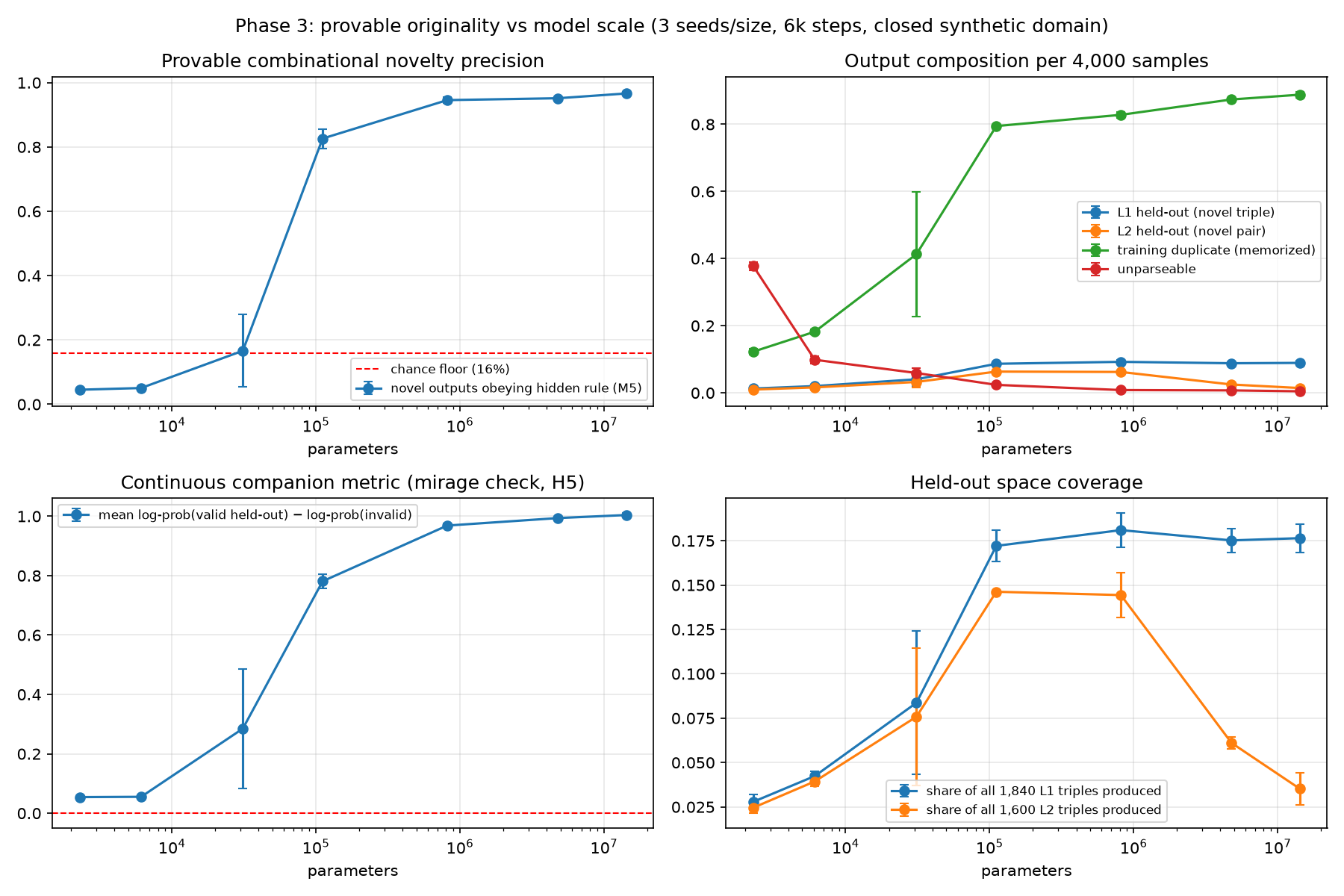
Provable originality vs model scale (3 seeds/size, error bars = spread). Top-left: the pass/fail novelty metric shows a textbook “emergent” jump. Bottom-left: the continuous companion metric is already climbing where pass/fail reads zero, the jump is a measurement threshold, not magic. Right panels: past ~111k params, bigger models memorize more and emit fewer novel inventions.
Three results live in that table.
Provable originality exists, cheaply. From 111k parameters up, models generate hundreds of distinct valid held-out inventions per 4,000 samples, the s3/s4 models produced ~320 distinct L1 and ~230 distinct L2 triples each, covering 14–18% of the entire held-out space, at 83% rule precision for the 111k model and 95% for the 816k one. Under the definition fixed at the start, that is original output: novel relative to everything the model has ever seen, and valid. The structural skeleton of an idea, a chemist who has internalized valence rules proposing a compound nobody has synthesized.
The “emergence” decomposed. The pass/fail metric does the classic emergent thing: flat at chance through 31k parameters, then one 3.6× size step later it’s at 0.83. But look at the continuous row underneath: at 31k, where pass/fail reads “nothing,” the log-prob gap is already 0.28 and climbing. Smooth competence growth, thresholded measurement. Steep and real, but not magic, my prior about the word “emergent” survived contact with the data.
Scale suppresses expression. Read the last two rows together. Past the size needed to learn the rule, bigger models know the rule better (precision 0.97, the widest log-prob gap) yet emit fewer novel items, memorized output climbs monotonically to 89% while distinct L2 novelties fall four-fold from their 111k–816k peak. No RLHF anywhere in these models; pure likelihood training concentrates output on the already-seen. My frontier-model observation, reproduced in a dish. (One confound to flag honestly: all sizes trained for the same 6,000 steps, so the larger models are also further into overfitting, scale and training progress are partially entangled in that trend.)
Experiment 4: is the collapse trained-in, and is it reversible?
The scale sweep showed collapse correlating with training; the last experiment made it causal. I pretrained a single s4 model (816k parameters, 6,000 steps as above), snapshotted the weights, and ran three continuations of 3,000 steps each from that identical snapshot (two seeds; evaluated with the full protocol every 500 steps):
- Control: keep training on the full training set.
- Preference: train only on a “preferred” slice, 2% of the training triples, one template. A deliberately crude simulation of what preference-tuning does: concentrate probability on a narrow high-reward distribution.
- Diversity: iterative self-training. Each round, sample 8,000 sentences at temperature 1.2; keep those that are grammatical, not in the training data, and not previously kept; fine-tune on them (mixed 4:1 with real data to anchor the grammar); repeat. Crucially, this arm gets no access to the hidden validity rule, the only signal is “new and well-formed,” which is an honest mirror of frontier reality, where no oracle for novelty-with-validity exists.
Endpoints after 3,000 steps (start point for all arms: 85% memorized, 506 distinct novel-valid per 4k samples, 0.96 precision):
| arm | memorized | distinct novel-valid /4k | rule precision |
|---|---|---|---|
| control | 87% | 465 | 0.97 |
| preference | 98% | 24 | 0.62 |
| diversity | 17% | 144 | 0.05 |
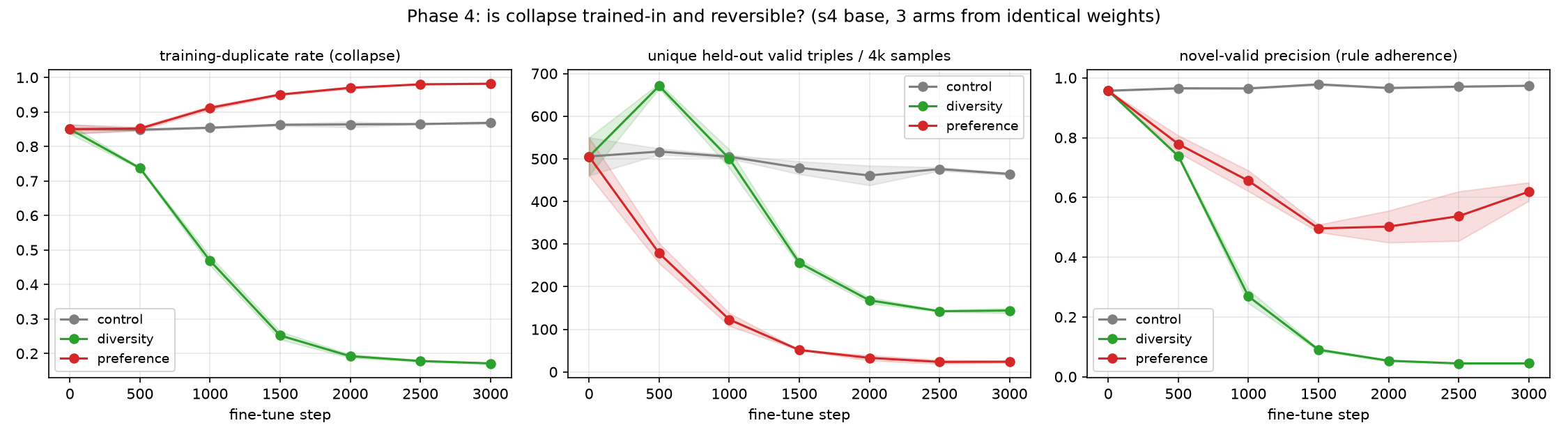 Three arms from one identical 816k-param snapshot. Left: collapse (memorization) rate. Middle: distinct novel-valid inventions per 4k samples, note the diversity arm’s spike at step 500. Right: rule precision, diversity’s craters as it trains on its own increasingly invalid output. The transient at step 500 (novelty ↑ and validity held) is the only point anywhere that had it all.
The preference arm is collapse manufactured on demand: a 20-fold cut in expressed novelty in 3,000 steps, and rule precision dropped too, over-concentration damaged the competence it was distilled from.
The diversity arm is the experiment’s punchline, in two acts. At step 500 it had beaten its own baseline on both axes, 671 distinct novel-valid inventions (up 33%) with duplicates down to 74% and precision still 0.74. The suppressed novelty was real and recoverable by training, not just by prompt tricks. Then, iterated further with nothing but “be new” as a signal, it ate itself: training on its own increasingly rule-breaking output, invalid share climbing from under 1% to 79% by step 3,000. Novelty without a validity check isn’t originality, optimizing it alone actively destroys the validity. Which, I’d note, is also true of people: humans who optimize pure novelty with no external check don’t produce originality either. They produce crankery.
Across all arms, no configuration held novel + valid + diverse simultaneously at convergence. The best point observed anywhere is that transient at diversity step 500, which suggests sustained machine originality needs an external validity signal (a verifier, a critic, the world) in the training loop, not just released pressure.
Where I landed
The question I was asked, will AI ever have original thought?, turned out to have the wrong verb tense. Under the only definition anyone can actually test, the answer is already yes: a 111k-parameter model provably produced valid structures from outside its entire training experience, hundreds of times per few thousand samples.
The real finding is why we don’t see this from the models we use every day: capability and behavior come apart. Every negative result in this project was about behavior, what gets sampled by default. Every positive result was about capability, what the model’s distribution supports. Likelihood training concentrates output on the familiar; preference-tuning concentrates it further onto the polished consensus answer. We are, in effect, trading away expressed originality for reliability. My same-idea-every-time experiment was an accurate observation of that trade and a false inference about the ceiling.
The boundaries of the claim, stated plainly: this demonstrates combinational originality, new valid points in a fixed conceptual space. Whether models can transform a space, break the rules rather than recombine within them, is untouched by the closed-world method, by design, since the world’s rules are fixed. The toy world’s sentences carry no semantic richness; the claim is that the load-bearing mechanism skeptics say is impossible demonstrably exists, not that it yet amounts to ideas like ours. And the bridge from a 14M-parameter dish to frontier models is an argument from shared architecture, shared objective, and matching collapse phenomenology, strong, but an argument, not a proof.
Three practical takeaways if you want original ideas from an LLM today: inject entropy into the prompt (random words, random domains) rather than only raising temperature, in my tests it was worth roughly 5× more effective diversity; never trust a model’s claim that something “has not been done before,” because it cannot check; and when a model gives you the same answer every time, you’ve learned where its probability mass sits, not what it’s capable of.
The gap between what these models express and what they contain is real, measurable, and, going by the diversity experiment, at least partly closable. That gap closing, not some future architecture, is where I’d now look for machine originality to show up.
The full code, the closed-world domain generator, the exact validity classifier, all training scripts, and every result table and plot are on GitHub: github.com/mikegc-aws/original-thought.
References
- Boden, M. A. (1990). The Creative Mind: Myths and Mechanisms. London: Weidenfeld & Nicolson. (2nd ed., Routledge, 2004.), origin of the psychological (P-creativity) vs. historical (H-creativity) distinction. Restated for AI in: Boden, M. A. (1998). “Creativity and artificial intelligence.” Artificial Intelligence, 103(1–2), 347–356. https://doi.org/10.1016/S0004-3702(98)00055-1
- Friedman, D., & Dieng, A. B. (2023). “The Vendi Score: A Diversity Evaluation Metric for Machine Learning.” Transactions on Machine Learning Research. arXiv:2210.02410. https://arxiv.org/abs/2210.02410
- Schaeffer, R., Miranda, B., & Koyejo, S. (2023). “Are Emergent Abilities of Large Language Models a Mirage?” Advances in Neural Information Processing Systems (NeurIPS) 36. arXiv:2304.15004. https://arxiv.org/abs/2304.15004